FUZZY SET THEORY
In mathematics, fuzzy sets (a.k.a. uncertain sets) are sets whose elements have degrees of membership. Fuzzy sets were introduced independently by Lotfi A. Zadeh in 1965 as an extension of the classical notion of set.[1][2] At the same time, Salii (1965) defined a more general kind of structure called an L-relation, which he studied in an abstract algebraic context. Fuzzy relations, which are now used throughout fuzzy mathematics and have applications in areas such as linguistics (De Cock, Bodenhofer & Kerre 2000), decision-making (Kuzmin 1982), and clustering (Bezdek 1978), are special cases of L-relations when L is the unit interval [0, 1].
In classical set theory, the membership of elements in a set is assessed in binary terms according to a bivalent condition—an element either belongs or does not belong to the set. By contrast, fuzzy set theory permits the gradual assessment of the membership of elements in a set; this is described with the aid of a membership function valued in the real unit interval [0, 1]. Fuzzy sets generalize classical sets, since the indicator functions (aka characteristic functions) of classical sets are special cases of the membership functions of fuzzy sets, if the latter only takes values 0 or 1.[3] In fuzzy set theory, classical bivalent sets are usually called crisp sets. The fuzzy set theory can be used in a wide range of domains in which information is incomplete or imprecise, such as bioinformatics.[4]
Definition[edit]
A fuzzy set is a pair where is a set (often required to be non-empty) and a membership function. The reference set (sometimes denoted by or ) is called universe of discourse, and for each the value is called the grade of membership of in . The function is called the membership function of the fuzzy set .


![{\displaystyle m\colon U\rightarrow [0,1]}](https://wikimedia.org/api/rest_v1/media/math/render/svg/6d2ca07bd2c46e39ef87ed3ce24798d5235c3cf3)


For a finite set the fuzzy set is often denoted by


Let . Then is called

- not included in the fuzzy set if (no member),
- fully included if (full member),
- partially included if (fuzzy member).[5]


The (crisp) set of all fuzzy sets on a universe is denoted with (or sometimes just ).[6]


[edit]
For any fuzzy set and the following crisp sets are defined:
![\alpha \in [0,1]](https://wikimedia.org/api/rest_v1/media/math/render/svg/ffaa893dfc528b3772eeb4b35a2320f89f02f48f)
- is called its α-cut (aka α-level set)
- is called its strong α-cut (aka strong α-level set)
- is called its support
- is called its core (or sometimes kernel ).





Note that some authors understand "kernel" in a different way; see below.
Other definitions[edit]
- A fuzzy set is empty () iff (if and only if)



- Two fuzzy sets and are equal () iff



- A fuzzy set is included in a fuzzy set () iff


- For any fuzzy set , any element that satisfies
- is called a crossover point.

- Given a fuzzy set , any , for which is not empty, is called a level of A.
- The level set of A is the set of all levels representing distinct cuts. It is the image of :


![{\displaystyle \Lambda _{A}=\{\alpha \in [0,1]:A^{=\alpha }\neq \varnothing \}=\{\alpha \in [0,1]:{}}](https://wikimedia.org/api/rest_v1/media/math/render/svg/af010b0fe97b9271f35619229fc82bd7681c6dfb)


- For a fuzzy set , its height is given by
- where denotes the supremum, which exists because is non-empty and bounded above by 1. If U is finite, we can simply replace the supremum by the maximum.



- A fuzzy set is said to be normalized iff
- In the finite case, where the supremum is a maximum, this means that at least one element of the fuzzy set has full membership. A non-empty fuzzy set may be normalized with result by dividing the membership function of the fuzzy set by its height:
- Besides similarities this differs from the usual normalization in that the normalizing constant is not a sum.



- For fuzzy sets of real numbers (U ⊆ ℝ) with bounded support, the width is defined as
- In the case when is a finite set, or more generally a closed set, the width is just
- In the n-dimensional case (U ⊆ ℝn) the above can be replaced by the n-dimensional volume of .
- In general, this can be defined given any measure on U, for instance by integration (e.g. Lebesgue integration) of .



- A real fuzzy set (U ⊆ ℝ) is said to be convex (in the fuzzy sense, not to be confused with a crisp convex set), iff
- .
- Without loss of generality, we may take x ≤ y, which gives the equivalent formulation
- .
- This definition can be extended to one for a general topological space U: we say the fuzzy set is convex when, for any subset Z of U, the condition
- holds, where denotes the boundary of Z and denotes the image of a set X (here ) under a function f (here ).
![{\displaystyle \forall x,y\in U,\forall \lambda \in [0,1]:\mu _{A}(\lambda {x}+(1-\lambda )y)\geq \min(\mu _{A}(x),\mu _{A}(y))}](https://wikimedia.org/api/rest_v1/media/math/render/svg/b420325908f2dcfc55c2aa9542a06f57adeb6284)
![{\displaystyle \forall z\in [x,y]:\mu _{A}(z)\geq \min(\mu _{A}(x),\mu _{A}(y))}](https://wikimedia.org/api/rest_v1/media/math/render/svg/1c0ede40821afbea579e569d7748db83ec18dbde)



Fuzzy set operations[edit]
Although the complement of a fuzzy set has a single most common definition, the other main operations, union and intersection, do have some ambiguity.
- For a given fuzzy set , its complement (sometimes denoted as or ) is defined by the following membership function:


- .

- Let t be a t-norm, and s the corresponding s-norm (aka t-conorm). Given a pair of fuzzy sets , their intersection is defined by:


- ,
- and their union is defined by:
- .



By the definition of the t-norm, we see that the union and intersection are commutative, monotonic, associative, and have both a null and an identity element. For the intersection, these are ∅ and U, respectively, while for the union, these are reversed. However, the union of a fuzzy set and its complement may not result in the full universe U, and the intersection of them may not give the empty set ∅. Since the intersection and union are associative, it is natural to define the intersection and union of a finite family of fuzzy sets recursively.
- If the standard negator is replaced by another strong negator, the fuzzy set difference may be generalized by
![{\displaystyle n(\alpha )=1-\alpha ,\alpha \in [0,1]}](https://wikimedia.org/api/rest_v1/media/math/render/svg/f81ebfea6baaa4c5957f842064b3028677741563)

- The triple of fuzzy intersection, union and complement form a De Morgan Triplet. That is, De Morgan's laws extend to this triple.
- Examples for fuzzy intersection/union pairs with standard negator can be derived from samples provided in the article about t-norms.
- The fuzzy intersection is not idempotent in general, because the standard t-norm min is the only one which has this property. Indeed, if the arithmetic multiplication is used as the t-norm, the resulting fuzzy intersection operation is not idempotent. That is, iteratively taking the intersection of a fuzzy set with itself is not trivial. It instead defines the m-th power of a fuzzy set, which can be canonically generalized for non-integer exponents in the following way:
- For any fuzzy set and the ν-th power of is defined by the membership function:


The case of exponent two is special enough to be given a name.
- For any fuzzy set the concentration is defined
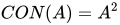

Taking , we have and


- Given fuzzy sets , the fuzzy set difference , also denoted , may be defined straightforwardly via the membership function:


- which means , e. g.:



- Another proposal for a set difference could be:

- Proposals for symmetric fuzzy set differences have been made by Dubois and Prade (1980), either by taking the absolute value, giving
- or by using a combination of just max, min, and standard negation, giving


- Axioms for definition of generalized symmetric differences analogous to those for t-norms, t-conorms, and negators have been proposed by Vemur et al. (2014) with predecessors by Alsina et al. (2005) and Bedregal et al. (2009).[7]
- In contrast to crisp sets, averaging operations can also be defined for fuzzy sets.

Comments
Post a Comment