Integral equation
Integral equation
In mathematics, integral equations are equations in which an unknown function appears under an integral sign.[1] In mathematical notation, integral equations may thus be expressed as being of the form:




Classification and overview[edit]
Various classification methods for integral equations exist. A few standard classifications include distinctions between linear and nonlinear; homogenous and inhomogenous; Fredholm and Volterra; first order, second order, and third order; and singular and regular integral equations.[1] These distinctions usually rest on some fundamental property such as the consideration of the linearity of the equation or the homogeneity of the equation.[1] These comments are made concrete through the following definitions and examples:
Linearity[edit]
Linear: An integral equation is linear if the unknown function u(x) and its integrals appear linear in the equation.[1] Hence, an example of a linear equation would be:[1]

Nonlinear: An integral equation is nonlinear if the unknown function u(x) or any of its integrals appear nonlinear in the equation.[1] Hence, examples of nonlinear equations would be the equation above if we replaced u(t) with , such as:


- Nonlinear Volterra integral equations of the second kind which have the general form: where F is a known function.[3]
- Nonlinear Fredholm integral equations of the second kind which have the general form: .[3]
- A special type of nonlinear Fredholm integral equations of the second kind are given by the form: , which has the two special subclasses:[3]





More information on the Hammerstein equation and different versions of the Hammerstein equation can be found in the Hammerstein section below.
Location of the unknown equation[edit]
First kind: An integral equation is called an integral equation of the first kind if the unknown function appears only under the integral sign.[3] An example would be: .[3]
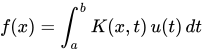
Second kind: An integral equation is called an integral equation of the second kind if the unknown function appears also outside the integral.[3]
Third kind: An integral equation is called an integral equation of the third kind if it is a linear Integral equation of the following form:[3]

Limits of Integration[edit]
Fredholm: An integral equation is called a Fredholm integral equation if both of the limits of integration in all integrals are fixed and constant.[1] An example would be that the integral is taken over a fixed subset of .[3] Hence, the following two examples are Fredholm equations:[1]

- Fredholm equation of the first type: .
- Fredholm equation of the second type:

Note that we can express integral equations such as those above also using integral operator notation.[7] For example, we can define the Fredholm integral operator as:
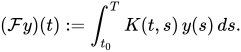

Volterra: An integral equation is called a Volterra integral equation if at least one of the limits of integration is a variable.[1] Hence, the integral is taken over a domain varying with the variable of integration.[3] Examples of Volterra equations would be:[1]
- Volterrra integral equation of the first kind:
- Volterrra integral equation of the second kind:
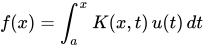

As with Fredholm equations, we can again adopt operator notation. Thus, we can define the linear Volterra integral operator , as follows:[3]

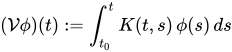
![{\displaystyle t\in I=[t_{0},T]}](https://wikimedia.org/api/rest_v1/media/math/render/svg/ba38e74d02f3f3b74052376de9dc8f5984a9b3e6)

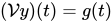








![{\displaystyle [a,b]=I}](https://wikimedia.org/api/rest_v1/media/math/render/svg/74a9b42d9ffd14e04d70f1a4b61bd994d399ed0e)


Comments
Post a Comment