Homogeneity[edit]
Homogenous: An integral equation is called homogeneous if the known function  is identically zero.[1]
Inhomogenous: An integral equation is called homogeneous if the known function is nonzero.[1]
Regularity[edit]
Regular: An integral equation is called regular if the integrals used are all proper integrals.[7]
Singular or weakly singular: An integral equation is called singular or weakly singular if the integral is an improper integral.[7] This could be either because at least one of the limits of integration is infinite or the kernel becomes unbounded, meaning infinite, on at least one point in the interval or domain over which is being integrated.[1]
Examples include:[1]

![{\displaystyle L[u(x)]=\int _{0}^{\infty }e^{-\lambda x}u(x)\,dx}](https://wikimedia.org/api/rest_v1/media/math/render/svg/7e87400008bd5b3115c3a5b83d2d5745301fd888)
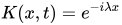 and
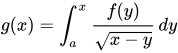
and 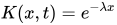 , respectively.[1] Another example of a singular integral equation in which the kernel becomes unbounded is:[1]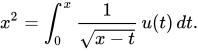
Integro-differential equations[edit]
An Integro-differential equation, as the name suggests, combines differential and integral operators into one equation.[1] There are many version including the Volterra integro-differential equation and delay type equations as defined below.[3] For example, using the Volterra operator as defined above, the Volterra integro-differential equation may be written as:[3]

 as:[3]

Volterra integral equations[edit]
Uniqueness and existence theorems in 1D[edit]
The solution to a linear Volterra integral equation of the first kind, given by the equation:
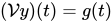
 , can be defined as follows:[3]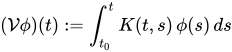
![{\displaystyle t\in I=[t_{0},T]}](https://wikimedia.org/api/rest_v1/media/math/render/svg/ba38e74d02f3f3b74052376de9dc8f5984a9b3e6) and K(t,s) is called the kernel and must be continuous on the interval
and K(t,s) is called the kernel and must be continuous on the interval  .[3]
.[3]The solution to a linear Volterra integral equation of the second kind, given by the equation:[3]

Volterra integral equations in  [edit]
A Volterra Integral equation of the second kind can be expressed as follows:[3]

![{\displaystyle (x,y)\in \Omega :=[0,X]\times [0,Y]}](https://wikimedia.org/api/rest_v1/media/math/render/svg/063a92efc7c9b62fc7579df50ff4e2f23ef8aacc) ,
,  ,
,  and
and  .[3] This integral equation has a unique solution
  given by:[3]
 is the resolvent kernel of K.[3]
Uniqueness and existence theorems of Fredhom-Volterra equations[edit]
As defined above, a VFIE has the form:

 and
and  being a closed bounded region in
  with piecewise smooth boundary.[3] The Fredholm-Volterrra Integral Operator
  is defined as:[3]
 , K is called the positive memory kernel.[3] With this in mind, we can now introduce the following theorem:[3]
Theorem — If the linear VFIE given by:  with
with 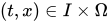 satisfies the following conditions:
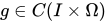 , and
, and where
where  and
and 
Then the VFIE has a unique solution 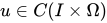 given by
  where
where 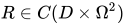 is called the Resolvent Kernel and is given by the limit of the Neumann series for the Kernel
  and solves the resolvent equations:
Special Volterra equations[edit]
A special type of Volterra equation which is used in various applications is defined as follows:[3]

 , and the Volterra integral operator
  is given by:
 .[3]
.[3]Converting IVP to integral equations[edit]
In the following section, we give an example of how to convert an initial value problem (IVP) into an integral equation. There are multiple motivations for doing so, among them being that integral equations can often be more readily solvable and are more suitable for proving existence and uniqueness theorems.[7]
The following example was provided by Wazwaz on pages 1 and 2 in his book.[1] We examine the IVP given by the equation:


If we integrate both sides of the equation, we get:
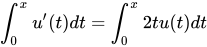
and by the fundamental theorem of calculus, we obtain:
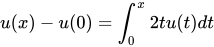
Rearranging the equation above, we get the integral equation:
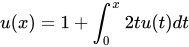
which is a Volterra integral equation of the form:

where K(x,t) is called the kernel and equal to 2t, and f(x)=1.[1]







Comments
Post a Comment