Power series solution for integral equations
Power series solution for integral equations[edit]
In many cases, if the Kernel of the integral equation is of the form K(xt) and the Mellin transform of K(t) exists, we can find the solution of the integral equation
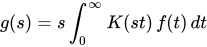
in the form of a power series

where

are the Z-transform of the function g(s), and M(n + 1) is the Mellin transform of the Kernel.
Numerical solution[edit]
It is worth noting that integral equations often do not have an analytical solution, and must be solved numerically. An example of this is evaluating the electric-field integral equation (EFIE) or magnetic-field integral equation (MFIE) over an arbitrarily shaped object in an electromagnetic scattering problem.
One method to solve numerically requires discretizing variables and replacing integral by a quadrature rule

Then we have a system with n equations and n variables. By solving it we get the value of the n variables

Integral equations as a generalization of eigenvalue equations[edit]
Certain homogeneous linear integral equations can be viewed as the continuum limit of eigenvalue equations. Using index notation, an eigenvalue equation can be written as
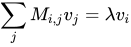
where M = [Mi,j] is a matrix, v is one of its eigenvectors, and λ is the associated eigenvalue.
Taking the continuum limit, i.e., replacing the discrete indices i and j with continuous variables x and y, yields
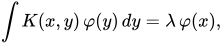
where the sum over j has been replaced by an integral over y and the matrix M and the vector v have been replaced by the kernel K(x, y) and the eigenfunction φ(y). (The limits on the integral are fixed, analogously to the limits on the sum over j.) This gives a linear homogeneous Fredholm equation of the second type.
In general, K(x, y) can be a distribution, rather than a function in the strict sense. If the distribution K has support only at the point x = y, then the integral equation reduces to a differential eigenfunction equation.
In general, Volterra and Fredholm integral equations can arise from a single differential equation, depending on which sort of conditions are applied at the boundary of the domain of its solution.
Wiener–Hopf integral equations[edit]

Hammerstein equations[edit]
A Hammerstein equation is a nonlinear first-kind Volterra integral equation of the form:[3]







![{\displaystyle y(t)=g(t)+({\mathcal {H}}y)(t)=g(t)+\int _{0}^{t}K(t,s)[y(s)+H(s,y(s))]\,ds}](https://wikimedia.org/api/rest_v1/media/math/render/svg/e394dd36cce515b0ce49e1b7f69fde8916f06319)






We can also write the Hammerstein equation using a different operator called the Niemytzki operator, or substitution operator, defined as follows:[3]


Applications[edit]
Integral equations are important in many applications. Problems in which integral equations are encountered include radiative transfer, and the oscillation of a string, membrane, or axle. Oscillation problems may also be solved as differential equations.


Comments
Post a Comment