Fourier integral operator
Fourier integral operator
In mathematical analysis, Fourier integral operators have become an important tool in the theory of partial differential equations. The class of Fourier integral operators contains differential operators as well as classical integral operators as special cases.
A Fourier integral operator is given by:


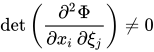
where denotes the Fourier transform of , is a standard symbol which is compactly supported in and is real valued and homogeneous of degree in . It is also necessary to require that on the support of a. Under these conditions, if a is of order zero, it is possible to show that defines a bounded operator from to .[1]



Examples[edit]
One motivation for the study of Fourier integral operators is the solution operator for the initial value problem for the wave operator. Indeed, consider the following problem:

and

The solution to this problem is given by

These need to be interpreted as oscillatory integrals since they do not in general converge. This formally looks like a sum of two Fourier integral operators, however the coefficients in each of the integrals are not smooth at the origin, and so not standard symbols. If we cut out this singularity with a cutoff function, then the so obtained operators still provide solutions to the initial value problem modulo smooth functions. Thus, if we are only interested in the propagation of singularities of the initial data, it is sufficient to consider such operators. In fact, if we allow the sound speed c in the wave equation to vary with position we can still find a Fourier integral operator that provides a solution modulo smooth functions, and Fourier integral operators thus provide a useful tool for studying the propagation of singularities of solutions to variable speed wave equations, and more generally for other hyperbolic equations.
Fourier inversion theorem
In mathematics, the Fourier inversion theorem says that for many types of functions it is possible to recover a function from its Fourier transform. Intuitively it may be viewed as the statement that if we know all frequency and phase information about a wave then we may reconstruct the original wave precisely.
The theorem says that if we have a function satisfying certain conditions, and we use the convention for the Fourier transform that


then
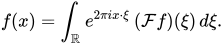
In other words, the theorem says that

This last equation is called the Fourier integral theorem.
Another way to state the theorem is that if is the flip operator i.e. , then



The theorem holds if both and its Fourier transform are absolutely integrable (in the Lebesgue sense) and is continuous at the point . However, even under more general conditions versions of the Fourier inversion theorem hold. In these cases the integrals above may not converge in an ordinary sense.
Statement[edit]
In this section we assume that is an integrable continuous function. Use the convention for the Fourier transform that

Furthermore, we assume that the Fourier transform is also integrable.


Comments
Post a Comment