SIMULTATION
SIMULTATION
Strictly speaking what we have described above is a simulation. The difference between a simulation and a model is that in a simulation we are concerned to try to get all of the details as right as possible so that the conclusions are as accurate as possible. Using such simulations we can, for example, determine in advance whether a bridge will stay up after it has been built. We can also test the bridge to destruction without ever having to build it in the first place simply by varying the parameters in the computer simulation. Another important use of simulation is in the training of pilots in aircraft simulators, which are designed to be as close to reality as possible. Using these, a pilot can be trained to fly an aircraft and to deal with dangerous situations, long before they have to enter the cockpit. One of my favourite examples of a simulator is the computer programme used by the line managers to control the operations of the London Underground. Simulators are also used at the heart of many video games. Two examples of such, shown below, are simulators of the underground and of a factory.
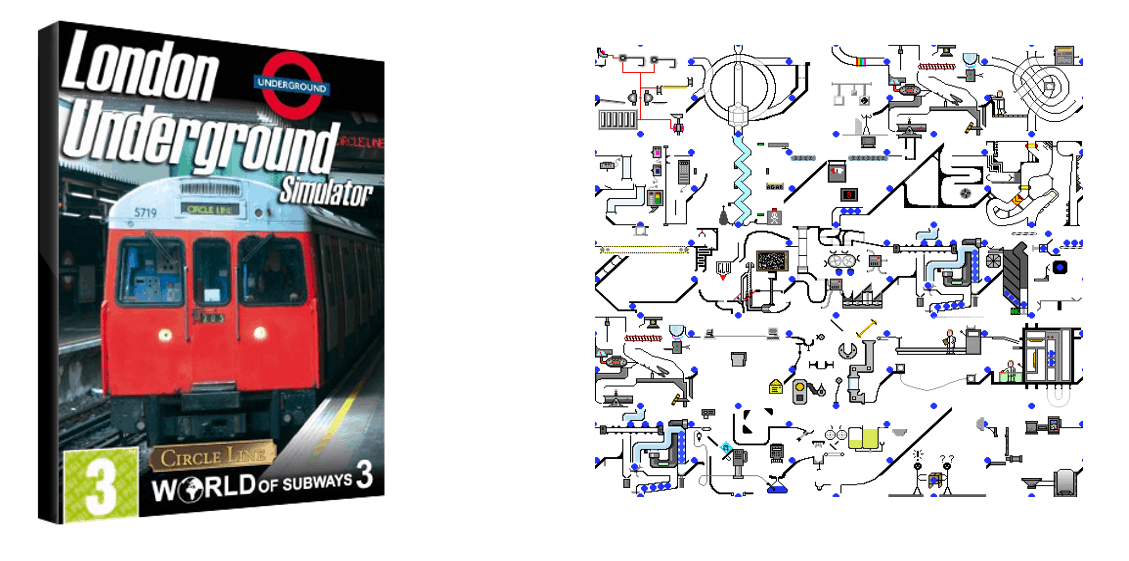 Whilst simulators are very useful, they have big disadvantages. The need for high accuracy means that the equations are usually far too hard to solve analytically. Instead, they must often be solved by using large super-computers. The bigger the computer the better. These simulations often take a long time, consume a lot of energy, and produce vast amounts of data. So much data in fact that it is often hard to work out what is important and what is irrelevant. Furthermore it is hard to use the simulations to do ‘what if’ experiments as they take so long to run and are expensive.
A second disadvantage is that they only tend to work, and be applied to, problems where the basic science is well understood. One reason for this is that it is a very significant amount of work (in person hours) to write and code a simulator. You do not want to put such an investment into a system which you do not understand well.
The Process of Mathematical Modelling
We contrast simulation with a mathematical model. This is a simplification of the problem to a small system of equations, which capture the essential essence of it, and, crucially, are simple enough to allow us to make analytical calculations. A formula derived from an analytical calculation can give a clear view of the role of the parameters in that system without having to run a very large number of calculations.
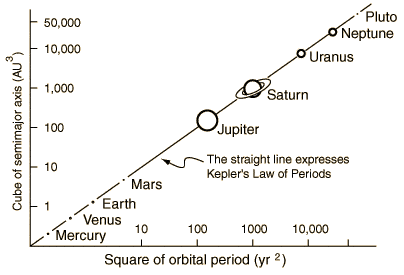
Perhaps the earliest example of a mathematical model of enormous predictive powers was Newton’s law of gravitation applied to the solar system. Rather than modelling the whole system in all of its complexity, he treated the Sun and the planets as single points. This allowed him to write down the basic equations of motion of the whole of the solar system.
 The process of simplification in constructing a model is hugely important, but also hard. A wonderful quote from Albert Einstein is:
A model should be as simple as possible, and no simpler
The ‘traditional’, and often taught, approach to constructing a mathematical model is as follows:
- Think about the problem in a mathematical way identifying all of the key ingredients
- Write down the relevant equations, simplifying as much as possible
- Solve the equations
- Compare the results against data
- If the results agree STOP
- If not then modify the equations, such as making them more complex and including new processes
- Repeat from 2 above.
This method of modelling is often taught in universities and at schools. However, there is one problem with this description of the modelling process. In general it is completely wrong. The reason that it is wrong is that it is very, very, rare to come anywhere close to writing down the right equations the first time. Indeed without looking hard at the data to start with, it is likely that the equations will not be anywhere close to the truth. The result is ‘mathematical models’ that might look nice are so far from the truth as to be practically useless. They are also often so simplified, that they also have no real mathematical interest either. In contrast true mathematical modelling plays close attention to the data at all stages of the process, employs computation at all times, and NEVER stops at line 5 above. A mathematical model is a living process, that if looked after well will continue to give insights into the system. Another problem with this approach is that point 4 is often very difficult. What does ‘agreeing with data’ really mean when it comes to a model of (say) loneliness. The best models are ones which give us excellent insight into the system which allow us to make useful future predictions. Quantitative agreement with actual data is often a bonus. Or to quote George Box [1]


Comments
Post a Comment